How Long Does Upholstery Take to Dry — and What to Do If It Feels Stiff Afterwards
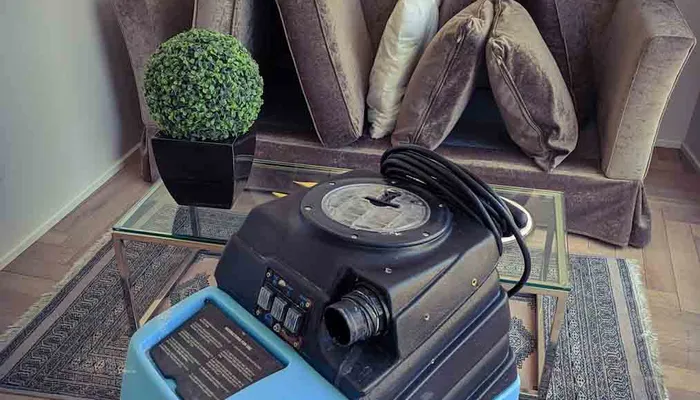
The short answer, because it is usually the only thing people want: up to 24 hours — for a sofa, a mattress, an armchair or a carpet cleaned in your home — and usually far less. Book a morning slot and you give the furniture the longest drying window; with good airflow it is normally usable that same evening.
The longer answer is worth reading, because drying time is the single best indicator of whether the job was done properly — and because a sofa that is still damp the next day, or that dries stiff, is telling you something specific.
Damp, not wet
Hot-water injection and extraction does exactly what the name says: solution goes into the fabric under pressure, and the vacuum stage pulls it back out. On a properly executed job we recover roughly 95% of the water we put in.
That 5% is what you are waiting on. The fabric should feel cool and slightly damp to the back of your hand when we leave — comparable to a shirt that has been through a spin cycle. It should not feel wet, and you should not be able to press a cushion and see water rise to the surface. If you can, too much went in or not enough came out, and the drying time you are facing is measured in days rather than hours.
What actually controls the speed
Airflow, more than anything else. Moving air across the fabric carries evaporated water away; still air lets the room reach equilibrium and the drying stalls. This is why an open window with a fan pointed at the sofa will beat an air conditioner running in a sealed room.
Humidity is the second factor, and in Israel it varies enormously by where you live. On the coastal plain — Tel Aviv, Netanya, Haifa, Ashdod — summer humidity regularly sits above 70%, and drying genuinely takes longer than the same job in Jerusalem or Beer Sheva, where the air is far drier. If you are on the coast in August, plan for the upper end of the range.
The sharav is the exception that surprises people: hot, dry desert air is excellent drying weather, and a sofa cleaned during one can be ready in five or six hours even in Tel Aviv.
Then there is the piece itself. Thick foam holds more water than thin foam. A deep-seated sofa with dense cushions takes longer than a tight-backed one. Leather is fastest of all, because it is cleaned by hand rather than saturated.
How to speed it up
Open the windows on opposite sides of the room if you can, so air moves through rather than sitting. Point a standing fan at the sofa — not at full blast from close range, just steady movement across the surface. If it is too hot or humid outside to open up, run the air conditioner on dry mode rather than cool; dry mode is a dehumidifier and it is the right tool here.
Stand the seat cushions on end, leaning against the sofa back, so both faces are exposed instead of one being pressed flat against the deck. This is the single most effective thing you can do and it costs nothing. We usually leave them this way, and it is worth resisting the urge to put them straight back.
What not to do: do not put throws, covers or sheets over it to protect it, do not push it back against a wall while it is still damp, and do not close the room up and leave. All three trap moisture against the fabric, which is how a clean sofa develops a musty smell.
Can I sit on it before it is fully dry?
Better not to, and the reason is practical rather than precious. Damp fabric picks up dirt from clothing far more readily than dry fabric, so sitting on a sofa at hour four undoes a little of what you paid for. If you must, put a clean dry towel down first.
Carpets are a firmer no — walking on a damp carpet presses dirt from your feet back into fibres that are open and receptive. Wait until it is properly dry.
If it dries stiff or crunchy, something went wrong
This is the complaint we hear most often about work done by others, and it has one overwhelming cause: detergent left in the fabric.
If solution goes in and not enough is extracted, the soap stays behind and dries hard. That is the stiffness you are feeling. It is not the fabric having been damaged and it is not normal — a properly cleaned sofa dries soft, and if anything feels slightly fresher and more open than before.
The residue also causes a second problem that shows up weeks later. Dried detergent is sticky, so it attracts and holds dirt faster than clean fabric does. A sofa that looks visibly grubby again within a month of being cleaned was almost certainly not rinsed and extracted properly. People often conclude that cleaning "doesn't last", when what actually happened is that the job was left half-finished.
It is why our process ends with a rinse in a colour-safe solution followed by a final extraction pass with no cleaning agent in the line — the last thing through the fabric is clean water, and then air.
If it smells musty, that is a different problem
Stiffness means residue. A damp, sour or musty smell that appears a day or two later means over-wetting: water reached the foam and the frame, and it is drying too slowly to avoid going stale.
This is most common when someone uses carpet settings on upholstery. A carpet sits on a hard floor and dries from above; a sofa has thick foam underneath that holds water and releases it slowly. Rented machines are generally configured for carpet, which is a large part of why DIY attempts end this way.
If it happens, airflow is still the answer, and aggressively — fan on it, windows open, cushions off and standing. If the smell is still there after two or three days of that, the foam is holding water and it needs a professional to extract it properly.
What a good result feels like
The next morning, the fabric should be dry to the touch all the way through, including where the cushion meets the deck. It should feel soft, not board-like. It should smell of nothing in particular — not of perfume, not of soap, and certainly not of damp.
If it does not, that is worth a phone call rather than a shrug. On our own work it is covered by the warranty, and we would rather come back than have you live with it.
Send a photo and get a quote within minutes.